
Brackish Water in Wells: Saltwater Intrusion on Vancouver Island
What brackish water means for coastal well owners: how saltwater intrudes into Vancouver Island and Gulf Islands wells, the warning signs, and what you can do.

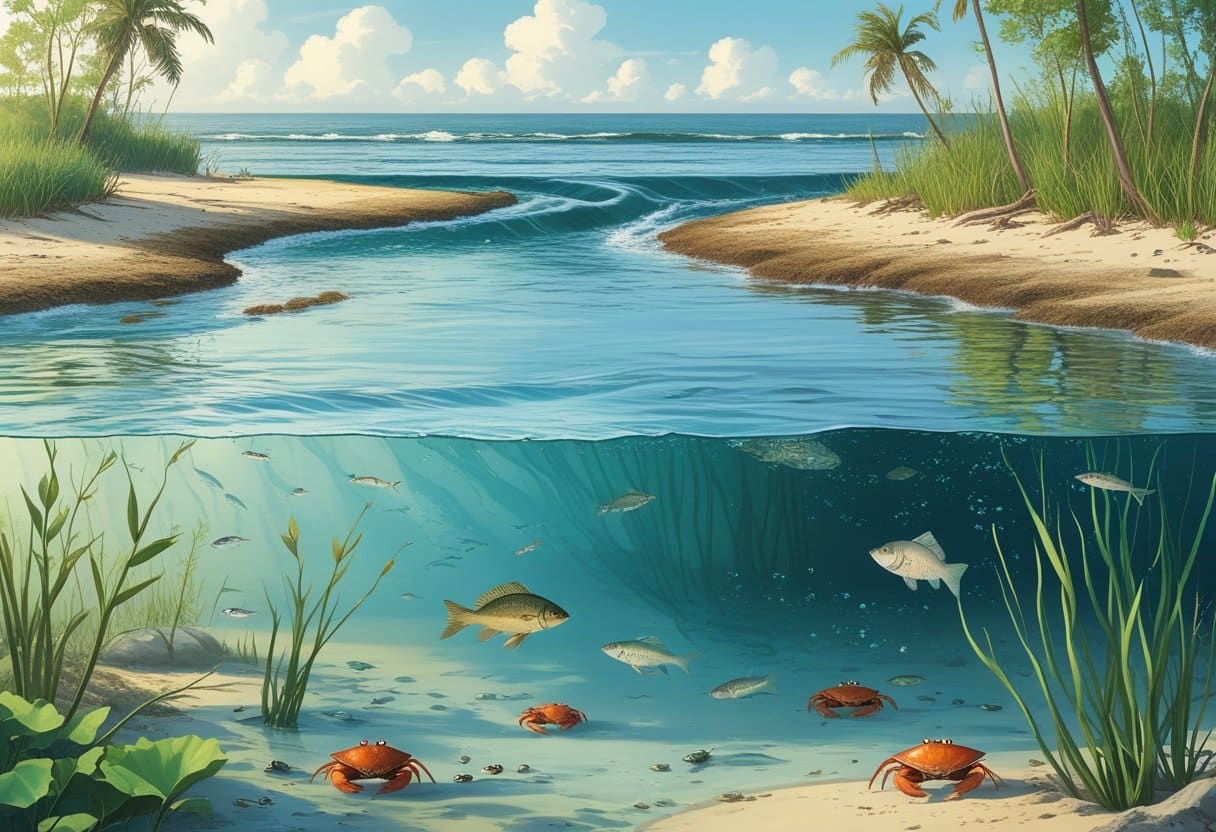
Brackish water is a word you mostly hear from boaters, aquarists and marine biologists. But on Vancouver Island, where many Island homes and farms rely on private wells, the brackish water that matters is the kind that shows up uninvited in your drinking well: seawater that has pushed its way into a fresh groundwater aquifer.
This is called saltwater intrusion — a recognized concern that the Province of B.C. addresses with its own best-practices guidance for well owners. Coastal Vancouver Island and Gulf Islands well owners are among the most exposed to it. This article explains what brackish water is, how and where seawater intrudes into Island aquifers, the warning signs to watch for, and what you can do about it.
What is brackish water?
In the simplest terms, brackish water sits between fresh water and seawater. The USGS defines brackish water as water with a salinity intermediate between seawater and freshwater — roughly 1,000 to 10,000 milligrams per litre of dissolved solids.
For a well owner, though, that textbook range is less important than the point at which your water stops being pleasant or safe to drink. The B.C. government’s guidance is far stricter, and it uses these numbers as operational targets for coastal wells (see below).
Why saltwater intrudes into coastal wells
Saltwater intrusion happens when saline water is drawn into a freshwater aquifer. The Province of B.C.’s fact sheet, Best Practices for Prevention of Saltwater Intrusion, explains the mechanics clearly:
- In coastal aquifers — and on islands like the Gulf Islands — fresh groundwater floats above the denser saltwater, forming a lens or wedge that extends inland from the shoreline.
- Under natural conditions, fresh groundwater flowing toward the sea holds the saltwater back. The boundary between the two is really a diffuse mixing zone, not a hard line.
- Pumping changes the balance. When too much fresh water is pumped out, the fresh-water flow toward the coast drops and saltwater is drawn landward, or upward toward the well. The U.S. Geological Survey describes the same process: groundwater pumping can reduce freshwater flow toward coastal areas and cause saltwater to be drawn into the freshwater zones of an aquifer, and in extreme cases wells are abandoned.
- In fractured bedrock — common in much of the Island — a single fracture can act as a conduit that delivers saltwater straight to a well.
- Some saline groundwater is natural rather than intruded. Water in deeper aquifers can be salty because of geologic processes and interactions between rocks and water over millennia, and a deep well can pull that saline water up to mix with fresher shallow groundwater.
Where it matters on Vancouver Island
Saltwater intrusion is not an equal-opportunity problem — location and pumping decide the risk. According to the province’s saltwater intrusion fact sheet, the areas at highest risk are:
- close to the coast;
- where the land slope is low to moderate;
- on peninsulas, or anywhere with a limited area for groundwater recharge;
- where there is a high density of wells; and
- where there are high rates of pumping from a single well or from many wells in a coastal area, especially where the static (non-pumping) groundwater level is at or below sea level.
This is not a hypothetical for the Island region. The province notes that isolated areas of saltwater have been found at relatively shallow depths (less than 50 m) in places including Saanich, Mayne Island, Salt Spring Island and near Parksville. If you live in a low-lying coastal area with neighbours on wells, your aquifer fits the profile that the province flags as higher risk.
The warning signs: chloride, conductivity and salty taste
Saltwater intrusion is usually detected through two easy-to-measure indicators: elevated chloride and higher electrical conductivity.
The province’s fact sheet gives clear, practical numbers:
- In coastal B.C., a well is considered affected by saltwater intrusion when its groundwater contains a chloride concentration greater than 150 mg/L, a specific conductivity greater than 1000 µS/cm, or total dissolved solids (TDS) greater than 700 mg/L. For coastal British Columbia these thresholds are operational objectives — a well should only be pumped if it can produce water of that quality or better.
- Water starts to taste noticeably salty when chloride reaches 250 mg/L, which is also the guideline for Canadian drinking water quality.
These levels can vary seasonally — they tend to be higher in summer — or climb over time as pumping continues. That is why one test is not enough: the province recommends sampling annually, preferably in the dry season, and tracking how the numbers change year to year.
Health and practical impacts
Brackish water in a well is more than a taste problem:
- Saltwater intrusion makes water unpotable (unpleasant to drink). The province warns that people with hypertension should not drink groundwater with a high salt content.
- Irrigating with saline groundwater can harm plants and reduce soil fertility.
- Once intrusion has occurred, the changes in the aquifer may be permanent, or may take many years to recover.
This is a “protect the aquifer while it is still fresh” problem rather than an easy fix later.
What coastal well owners can do
If your well is in a higher-risk coastal area, the province’s fact sheet lays out practical steps, many of which are about how the well was built and how it is pumped:
If you are drilling or altering a well
- Avoid siting a new well immediately adjacent to the coast — the province suggests avoiding locations within about 50 m of it.
- Avoid drilling excessively deep in areas near the coast, since the depth to the freshwater-saltwater interface varies locally.
- Avoid techniques such as hydrofracturing within about 100 m of the coast, because they can open fractures that connect directly with the sea.
- Drillers should monitor specific conductivity while drilling in coastal areas and stop to test chloride if readings climb.
How you pump matters
- Reduce use: conserve water, install low-flow appliances and irrigation, and fix leaks promptly. The province notes that many intrusion problems start with over-pumping caused by an unchecked leak.
- Lower the pump depth, and favour low-volume, high-frequency pumping (“well sipping”) to minimize drawdown.
- For multi-well systems, pump wells at different times rather than all at once.
- Consider adding storage (for example a cistern) so you can pump in the wet season for use in drier periods.
Monitor and test
- Test for chloride and electrical conductivity annually, ideally in the dry season, and keep a record of changes over time.
- Some owners install in-line conductivity meters that can shut the pump off automatically if readings climb above a set level.
Deal with problem wells
- A well that is severely affected may need to be rested — left unused for a period while you use an alternate supply — or, in the worst cases, decommissioned permanently. Decommissioning rules live in the Water Sustainability Act and the Groundwater Protection Regulation: unused wells with no plans for future use must be decommissioned, and abandoned wells, open boreholes and corroded casings can become pathways for saline water to move between aquifers. Under B.C. rules, decommissioning is a restricted activity that should be carried out by a registered well driller, and abandoned wells are to be reported to the province. See the B.C. government’s care and maintenance for well owners page for the decommissioning rules and how to find a registered driller.
Get qualified advice
- If you suspect intrusion, the province suggests consulting a qualified professional such as a hydrogeologist to assess the risk, interpret water-quality tests or design a monitoring program.
The bottom line for Island well owners
Brackish water does not have to come from an estuary or a tropical lagoon to affect you — in coastal well country it is the name for what happens when seawater intrudes into the fresh groundwater your well depends on. If you live near the coast on Vancouver Island or the Gulf Islands, especially in a low-lying area with a high density of wells, it pays to know your well’s baseline water quality and to watch chloride and conductivity over time.
Island Well Service works with coastal well owners across Vancouver Island every day. If your water has developed a salty taste, or you would like help understanding your latest water test results and what they mean for your pump and aquifer, get in touch — we can talk through monitoring, pumping changes, and what to do if saltwater is getting into your well.